by Bob Goosmann
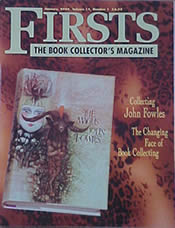
The following article originally appeared in the January 2004 issue of Firsts Magazine, the leading publication in the world for book collectors and dealers. This issue includes a checklist of Fowles first editions (with values and identifiers), along with more than 20 photographs of first edition dust jackets and several shots of Lyme Regis, setting of The French Lieutenant’s Woman and Fowles’ home for many years. To obtain a copy of this issue or to subscribe to Firsts, visit their web site at www.firstsmagazine.com.
(Note: to view our selection of John Fowles first editions and related items for sale–the largest in the world–click here).
A few years ago, when a panel of scholars and writers compiled a list of the 100 greatest novels of the 20th century, John Fowles came in at number 93 with his book The Magus. Had the list been narrowed to the 1960s and 1970s—decades that saw Fowles at the peak of his literary powers—it certainly would also have included The Collector and The French Lieutenant’s Woman, and perhaps Daniel Martin as well. Indeed, the “big four” of the Fowles canon are enough to ensure him a prominent spot in the annals of British literature.
Yet many a contemporary reader might be hard-pressed to immediately place Fowles. His novels were best-selling in their day and are all still in print; in addition, four have been adapted for the screen (one of which was nominated for several Academy Awards). But his work has always been considered quite “literary,” and this, combined with his reclusive nature and a lack of new fiction since the mid-1980s, has resulted in a retreat from the popular mind. Still, Fowles commands a fierce loyalty among his readers, who revel in his ability to manipulate them in much the same way he manipulates his fictional characters. Today, he is rightly considered one of Great Britain’s living literary giants.
John Robert Fowles was born on March 31, 1926 in Leigh-on-Sea, a suburb of London, the only child of Gladys and Robert Fowles (the latter a cigar importer). His one sibling, a sister, is 15 years younger, so he basically grew up as an only child—a fact that may have contributed to Fowles’ preference for solitude over society, particularly the serenity of nature. As a young boy Fowles was introduced to the wonders of the outdoors by his uncle, including the art of butterfly collecting. Fowles’ later rejection of the concept of “collecting” living creatures was to gain dramatic expression in his first novel.
Fowles was a hard-working student, and at the age of 13 was one of just three in his class to win a scholarship to Bedford, a prestigious boys’ school. While continuing to excel academically at Bedford, he also enjoyed considerable athletic success on the rugby and cricket teams. But looking back, Fowles has described the school as “a proper English institution…traditional, academically demanding, and brutal.” Indeed, from early on in his life he felt stifled by both the academic establishment and the properly “English” household of his upbringing.
This did not, however, prevent him from pursuing a career in the Royal Marines, with the intention of serving England in the battle against Hitler. But fate intervened, and Fowles completed his recruit training on May 8, 1945—the day the war ended in Europe. He soon decided to leave the military and revolt against his bourgeois background, the first step toward an embracing of nonconformity that would have a major impact upon his future writing.
The next stop for Fowles was Oxford, where he earned an honors degree in French. His interest in the concepts of free will and hazard—later to become primary themes in his novels—was growing, as was his affinity for the random complexity of nature. At university he began to compose stories and poems, influenced by the existentialism of writers such as Sartre and Camus. By the age of 21 he was determined to become a published writer, but it would be 16 more years before the appearance of his first novel.
Fowles spent 1950-1951 as a professor of English literature at a university in France, during which time he taught himself Latin and continued to write. He then made a decision that would have a profound impact on both his literary career and personal life, declining an opportunity to teach at a university in England in favor of a position teaching English as a second language at a Greek boarding school on the island of Spetses, about 60 miles southwest of Athens. It was here that Fowles first met his future wife, Elizabeth, who at the time was married to another teacher. The school and its surroundings would also subsequently provide a setting for The Magus, and a passage from an early chapter in the novel illustrates how much Fowles (and the main character) had fallen under the spell of Greece:
“It was a Sunday in late May, blue as a bird’s wing. I climbed up the goatpaths to the island’s ridge-back, from where the green froth of the pine-tops rolled two miles down to the coast. The sea stretched like a silk carpet across to the shadowy wall of mountains on the mainland to the west, a wall that reverberated away south, fifty or sixty miles to the horizon, under the vast bell of the empyrean. It was an azure world, stupendously pure, and as always when I stood on the central ridge of the island and saw it before me, I forgot most of my troubles. I walked along the central ridge, westwards, between the two vast views north and south. Lizards flashed up the pine trunks like living emerald necklaces. There was thyme and rosemary, and other herbs; bushes with flowers like dandelions dipped in sky, a wild, lambent blue.”
Unfortunately Fowles was not as enamored of the school itself, where he was expected to recreate for the Greek boys the sort of regimented environment that he had detested when attending Bedford. He found this academic approach to be very odd, and comments in his introduction to the revised version of The Magus, “if I had attempted a true portrait of the school, I should have been committed to a comic novel.” In early 1953, when he and the other teachers tried to implement some progressive reforms, they were all fired.
Fowles subsequently returned to England and continued his teaching career, while concurrently working on various drafts of The Magus. He also began keeping an enormous diary, to which he has contributed faithfully ever since (the first volume of his collected journals was recently published in the U.K.). In 1954 he married Elizabeth, who was to become not only his companion but also his muse. By 1960 he had written part or all of several novels, but his first attempt to become published was not until early 1962, when he submitted a travel book to a literary agent. The agent enjoyed the book but suggested to Fowles that his skills were more suited to writing fiction.
Taking this advice to heart, Fowles began work on The Collector, convinced a small-scale book (rather than one of his longer pieces) would be more marketable as a first novel. Two events influenced his conception of the book: he attended a performance of Bluebeard’s Castle—an opera about imprisoned women—and he came across a newspaper account of a young man who had kidnapped a girl and held her for over three months in a backyard air raid shelter outside London. Fowles wrote the first draft in less than a month. In July 1962, he took his manuscript to Tom Maschler, the literary director at Jonathan Cape who was to become his life-long editor and good friend. Maschler was electrified by The Collector, concluding that he had never read such a well-written first novel, and a deal with Cape was quickly sealed.
The Collector tells the story of Frederick Clegg, a repressed and socially- marginal bank clerk whose hobby is collecting butterflies. Clegg wins a fortune in the lottery and buys a remote estate in the country, then kidnaps a beautiful and strong-willed young art student, Miranda, whom he has been watching from afar. What has since become a common theme in many lurid tales is handled with taste and sensitivity by Fowles. Clegg is not primarily interested in sex with Miranda; rather, he simply wants to possess her like one of his specimens. Their physical and intellectual battle of wills—and the underlying subtext of class struggle—is made more interesting by Fowles’ technique of having Clegg tell the story first, followed by Miranda’s point of view via her diary.
The Collector appeared in 1963 and was an immediate critical and commercial success. Cape handled the publishing in Great Britain (the true first edition, with an initial run of about 3,000 copies) and Little Brown in the United States, as would be the case with all of Fowles’ novels. The beautiful dust jacket by artist Tom Adams, who designed the cover art for Fowles’ first three novels, shows a lady’s lock of hair, a butterfly and a key. An interesting and rare variation to the British edition features black boards in lieu of the standard rust color, perhaps indicating a test run by Cape prior to the actual first printing. In 1965 The Collector was adapted into a well-received Hollywood film directed by William Wyler, with Terence Stamp and Samantha Eggar in the starring roles.
Not wanting to be labeled as only a novelist, Fowles chose an unconventional follow-up to The Collector: a non-fiction book of philosophical musings entitled The Aristos. Published in 1964, it includes a variety of observations on the nature of existence, reflecting Fowles’ wide-ranging interest in such areas as art, psychology, politics and religion (anticipating many of the themes subsequently found in his fiction). Although it appeared after the U.S. edition, Cape’s British first of The Aristos is likely the rarest Fowles mainstream book, with a run of probably less than a thousand. A revised version (with a new introduction) of The Aristos, which Fowles described as “shorter, clearer and less irritating,” appeared in 1970.
Fowles was now ready to pursue completion of The Magus, a novel that had haunted him for more than a decade. A long, complex and challenging book, The Magus tells the story of Nicholas Urfe, a cynical young Englishman who accepts a teaching post at a boarding school on a Greek island and quickly becomes drawn into an elaborate “game” by a wealthy recluse named Maurice Conchis. Reality and fantasy are deliberately confused as Conchis takes Nicholas on a roller coaster ride of staged deaths, erotic encounters and ultimate betrayal. Forced to confront his past transgressions and self-delusions, Nicholas learns valuable lessons about the meaning of life, love, hazard and free will.
The Magus is as intellectually stimulating as it is entertaining, and serves as perhaps the best example of Fowles’ great gift for writing fiction that combines grand ideas with an exhilarating plot. In the novel, he seamlessly incorporates a wide-ranging knowledge of a variety of disciplines without being heavy-handed while at the same time spinning a narrative web from which it is nearly impossible to break away. The book boasts numerous themes, perhaps the most prominent being the nature of freedom (only one of the novel’s 78 chapters features a title—the Greek work for “freedom”). Its ambiguous ending tends to catch many readers off guard, yet is completely in keeping with the life lesson that Conchis is attempting to share with Nicholas, and Fowles with his readers.
An alternative title Fowles considered for the book, “The Godgame,” is also telling, and he once described the novel as being “about the relationship between man and his conception of God.” However, he certainly did not mean this in the traditional sense of organized religion (which Fowles, as a confirmed atheist, eschews). The existential quest of Nicholas in The Magus, while orchestrated by the God-like Conchis, is grounded in the random complexities of everyday life; success is ultimately dependent on the achievement of self-knowledge, along with the ability to distinguish between fantasy and reality.
Although it initially received mixed reviews in England, The Magus was widely hailed by critics in the United States. Described as “brilliant” by The New York Times, “a work of genius” by The St. Louis Dispatch and “magnificently written” by The New York Review of Books, it also quickly became a cult novel on American college campuses. To this day it has generated more letters to the author than any of his other novels, and Fowles himself has said it is his personal favorite, although he wryly adds “in the sense that one might love a crippled child more than normal children.”
The Magus was published by Little Brown in January 1966 (although the copyright page says 1965); the British version from Cape appeared a few months later. The dust jacket once again features a stunning design by Tom Adams and, as with The Collector, the basic difference between the two versions is simply the size of the books (the U.S. edition being in a larger format). A small quantity of the Cape first editions featured a red wrap-around band, and copies with this intact are rare.
In 1968 20th Century Fox released a movie adaptation of The Magus starring Michael Caine, Anthony Quinn and Candice Bergen in one of her first roles. Unfortunately, the film failed to capture the essence of the novel and was utterly confusing to those who had not read the book, prompting scathing reviews. It was considered such a bomb that Woody Allen once said if he had his life to live over again, he would want everything exactly the same with the exception of seeing The Magus. Although it has acquired something of a cult status, Fowles himself (who wrote the screenplay and has a cameo in the movie) has called it “a disaster all the way down the line.” Still, The Magus—if adapted correctly—could someday be a terrific film or mini-series. In fact, the 1997 movie The Game starring Michael Douglas borrowed many of its plot points and themes, so much so that Fowles considered suing the producers for copyright infringement.
Fowles next novel was inspired by a dream he had of a woman standing on a quay staring out to sea, a figure that was to become the title character of The French Lieutenant’s Woman. After writing the first draft in about nine months, he spent the next two years revising, working line-by-line to create the illusion of Victorian prose and dialogue by lengthening sentences, deleting contractions and employing digressions. The result is a portrayal of England in 1867 that accurately captures various facets of the time—social conventions, class struggles, etc.—while at the same time mirroring the style of 19th century prose. Fowles set the novel in Lyme Regis, a small town located on England’s southern coast where he had recently begun living (and resides to this day).
The French Lieutenant’s Woman is the story of Sarah Woodruff, an attractive and mysterious governess (who has apparently been deserted by a French naval lieutenant following an affair), and Charles Smithson, a wealthy amateur paleontologist. Following a chance encounter, Charles’ interest is piqued by Sarah’s unusual history and he subsequently begins to fall in love with her. This puts him in a difficult position as he is already engaged to Ernestina, the innocent daughter of a prominent businessman. As Charles becomes increasingly involved with Sarah, he struggles with his obligation to Ernestina and a growing obsession to discover the truth about Sarah’s past. The novel also includes several authorial intrusions, with omniscient narrator Fowles speaking directly to the reader about the mores of life in Victorian England and various possible outcomes for his characters.
As he did in The Magus, Fowles uses The French Lieutenant’s Woman to meditate on the nature of individual freedom—and ultimately its price. He initially feared the book would be too cerebral for popular audiences, but in fact it was both a huge critical and commercial success. Reviews were outstanding on both sides of the Atlantic, and Fowles received the W.H. Smith award for the year’s most outstanding contribution to British literature. The French Lieutenant’s Woman was the second highest selling novel in the U.S. in 1970, topped only by Erich Segal’s Love Story, and is today recognized as one of the seminal works of the latter half of the 20th Century.
The French Lieutenant’s Woman was published in 1969, initially by Cape, making it and The Collector the only Fowles novels to appear first in Great Britain. The U.S. edition from Little Brown is notorious for its poorly-made black dust jacket which is extremely difficult to find in fine condition. In 1981 the novel was adapted for the screen by Harold Pinter, with Jeremy Irons playing Charles and Meryl Streep in the title role. The novel’s dual nature and alternate endings were incorporated by turning the book into a modern-day movie about the making of a movie set in Victorian England. The resulting film was extremely successful and received five academy award nominations; Fowles, who had been disappointed with the two previous adaptations of his novels, called it “a brilliant metaphor” for the book.
Following publication of The French Lieutenant’s Woman, Fowles began composing his next novel, Daniel Martin. However, he took a break during its writing to publish The Ebony Tower, a collection of five short stories. The title story—and by far longest piece in the book—concerns the visit of art critic David Williams to the manor of elderly painter William Breasley, who lives in seclusion with two young female assistants. The cantankerous Breasley represents the artistic, free-spirited aspect of painting, while Williams is more controlled and intellectual. They ultimately engage in a verbal battle regarding the meaning and value of art, and the married Williams struggles with his increasing attraction to one of the women.
The four short stories in The Ebony Tower include three original works, plus the translation of an ancient fable. “Poor Koko” is the tale of a writer who is surprised by a burglar one night at a country cottage, tied up and ultimately forced to watch as the manuscript he is working on is burned in the fireplace. “The Enigma” concerns the baffling disappearance of a prominent businessman, and the frustrated attempts of a detective to unravel the mystery. “The Cloud” concerns a group of English acquaintances—one of whom has recently lost her husband to suicide—on vacation in the French countryside, and the various dynamics between them. A fourth story, “Eliduc,” is Fowles’ translation of a French medieval tale involving a knight and his struggle to be honorable to a pair of kings and a pair of women. Throughout the book, themes prevalent in Fowles’ earlier fiction—the nature of freedom, the effect of hazard on one’s life, and the power of fantasy—are again explored in a thoughtful and entertaining manner.
The Ebony Tower was published in 1974, and reviews of the book were excellent. The London Observer claimed it was “the best thing Fowles has written,” while the Baltimore Sun called it “brilliant.” It also sold quite well, especially for a collection of short stories, spending over six months on the New York Times bestseller list. A year following its publication, the title story was adapted into a successful film for British television, with Laurence Olivier as Breasley and a young Greta Scacci as one of his assistants.
Fowles now returned to work on Daniel Martin, which became his longest novel at over 700 pages. It is—in his own words—“intended as a defense and illustration of an unfashionable philosophy, humanism, and also an exploration of what it is to be English.” The book spans four decades in the life of the title character, a self-absorbed English screenwriter living in Hollywood who is struggling to write a novel. He is summoned back to England for the funeral of an old friend, whose widow is the sister of his ex-wife. The two rekindle their old friendship as Daniel attempts to rectify some of the mistakes and omissions from his past.
With Daniel Martin, Fowles takes a wide-ranging approach to themes relating to friendship, love, the nature of art, and the meaning of life itself. The exhilarating narrative style of his previous novels is sacrificed to a certain extent, with the focus more on well-rounded characters and long-term relationships. The result is Fowles’ most mature novel, and probably his most autobiographical as well. Reviews of the book were strangely skewed—much like the initial reception of The Magus—with British reviewers finding it too long and preachy, and American reviewers being extremely favorable. Writer John Gardner spoke of Daniel Martin in superlative terms, calling Fowles “the only novelist now writing in English whose works are likely to stand as literary classics—the only writer…who has the power, range, knowledge and wisdom of a Tolstoi or James.”
Daniel Martin was published in 1977. Both versions of the first edition feature a plain green dust jacket, and the book’s binding seems to hold up well despite the large size. A little-known point of issue exists on the U.S. dust jacket: the rear flap features a brief biography of Fowles, which concludes with a mention of his home in Lyme Regis. A second state jacket omits this, in response to Fowles’ increasing frustration with the ever-growing number of tourists flocking to his beloved hamlet.
The Magus—A Revised Version was also published in 1977, as Fowles found it impossible to stay away from his masterpiece (which he always felt had appeared somewhat prematurely, before he had matured as a novelist). The revised version features a new forward by Fowles and several rewritten scenes. Although the basic plot remains the same, changes include a more explicit eroticism—not as acceptable when Fowles began working on the original in the 1950s—less of a supernatural element, and a somewhat less ambiguous ending. Opinions seem divided on which version is better, with those who first read the book in its original form usually preferring that version, and vice versa. What is clear, however, is that Fowles has remained somewhat obsessed by The Magus over the years, as have many of its readers.
Fowles next novel, Mantissa, was originally intended to be privately published in a quantity of just 100 copies. However, contractual obligations to Cape and Little Brown ultimately forced Fowles to agree to its mainstream publication. The shortest of Fowles’ novels at just 196 pages, Mantissa tells the story of a writer named Miles Green who awakens in a hospital bed suffering from amnesia. He subsequently has several apparently imaginary dialogues with Erato, his muse, who assumes various forms throughout the novel. Themes include the struggle inherent to the creative process, the relationship between an author, his characters and the reader, and the clash of the sexes.
Mantissa is the only novel by Fowles to receive a majority of negative reviews, and even his wife expressed the wish that he had never published it. Although the book examines many familiar themes from his previous novels, it lacks the narrative strength that has always been a hallmark of Fowles’ work, and in the end can at best be viewed as an amusing trifle. Fowles himself has noted “I knew that most people would disapprove of (Mantissa)…I wanted to give people the opportunity to kick me—which they duly did.”
Fowles’ most recent novel, A Maggot, appeared in 1986. The title refers not to an insect larva but to a secondary meaning of the word, “a whim or extravagant notion.” Indeed, A Maggot once again illustrates Fowles’ playful penchant for experimenting with literary genres and conventions. At first glance it appears to be an 18th century historical novel, complete with the reproduction of genuine-looking documents and actual excerpts from a magazine of the time in question. The reader, however, soon realizes that the narrator is unreliable and very little is to be taken at face value.
A Maggot begins with a small group of travelers on horseback crossing the countryside in 1736. Before their journey ends, one of them will disappear, another will be hanged, and the others will face trial for murder. Subsequent mystical events and possible contact with travelers from the future lead to the founding of a new religious faith: the rather odd—and now defunct—Shakers. Although reviews of A Maggot were somewhat mixed, it represented a return to form by Fowles after the disappointment of Mantissa. Those who did like the book liked it immensely, with the Washington Post citing it as “miraculous…a bravura exercise of literary ingenuity” and the Philadelphia Enquirer calling the book “smart, cunning, bizarre and wickedly dazzling…Fowles is a genius.”
The years immediately following publication of A Maggot were not kind to Fowles. In 1988 he suffered a fairly serious stroke (while recovering in the hospital, he was outraged by the presumption of a doctor who told him he had lost his writing ability, only to laugh when he realized the doctor was using the word “righting,” as in balance). Fowles ultimately made a good recovery, but two years later his wife Elizabeth died of lung cancer. These two events combined did ultimately have a serious impact upon his writing, and although he has continued to publish essays and reviews, there has been no new fiction.
Fowles’ non-fiction output has been considerable over the years. Much of it has centered on nature and natural history, including books such as The Enigma of Stonehenge, Shipwreck and The Tree that feature text by Fowles in concert with beautiful photographs. The long essay in The Tree explores the impact of nature on his life, through recollections of his childhood and of his work as a mature artist (“the key to my fiction…lies in my relationship with nature”). Fowles has also collaborated on two stunning pictorial essays—Islands and Land—with photographer Fay Godwin.
Other non-fiction covers the gamut of Fowles’ interests, including a book of Poetry titled simply (published in the U.S. only), a translation from the original French of Cinderella, and several works on the history of Lyme Regis. The list of titles that Fowles has contributed forwards or afterwards to is lengthy, with highlights including The Book of Ebenezer Le Page (an obscure British novel from the early 1900s that he has championed), a version of The Hound of the Baskervilles, The Lost Domain (a French novel that served as one of the inspirations for The Magus), and a book on Thomas Hardy. Fowles has even edited a huge facsimile edition of the original manuscript of Monumenta Britannica, the first complete publication of notes and drawings by 17th century antiquary John Aubrey, whose work is considered essential to the understanding of British archeology.
In 1998 the book Wormholes appeared, a collection of Fowles’ non-fiction from his early days as a writer to the present which includes literary criticism and pieces on writing, culture, society and nature, along with a recent interview. Limited edition signed copies in slipcase were produced in both U.S. and British versions. Also worth noting is the upcoming publication of the first complete biography of Fowles, John Fowles–A Life in Two Worlds by Eileen Warburton, expected in Spring 2004.
In addition to Wormholes, there have been many other signed limited editions of Fowles’ novels issued throughout the years. The Franklin Library produced leather-bound versions of The French Lieutenant’s Woman and The Collector in 1979 and 1982, respectively, while Easton Press published a similar version of The French Lieutenant’s Woman in 1999. An interesting edition of The Magus—actually a second printing by Cape—was produced in England by The New Fiction Society, with their stamp and Fowles’ signature on the flyleaf. A special edition of The Ebony Tower featuring a signed tipped-in page was issued in a quantity of 250 at the same time as the true first edition. And both Mantissa and A Maggot have been produced in the U.S. signed in slipcase, with limitations of 500 and 350, respectively, while A Maggot has been issued signed in a glassine dust jacket in England (500 copies).
Likewise, several limited editions have been produced of essays by Fowles. These include: The Nature of Nature, a discourse on one of his favorite subjects (limitation of 250 copies); Of Memoirs and Magpies, in which Fowles discusses his own predilection for collecting (200 copies); and Behind the Magus, a look at the various events and people who influenced the writing of The Magus (200 copies). The latter is also available in an off-print subsequently produced for Fowles with a different cover to avoid copyright issues, also with a limitation of 200.
In recent years Fowles has kept a rather low profile, preferring to stay close to his Lyme Regis home for health reasons. In 1998 he remarried, to a long-time acquaintance and family friend named Sarah. The name has a lovely irony, recalling as it does one of Fowles’ most famous characters, Sarah Woodruff (the French Lieutenant’s Woman), who is introduced to readers standing on the wharf which actually exists just a few hundred yards from his current home. The blurring of art and real life is the sort of juxtaposition that can often been found in Fowles’ novels.
For Fowles, writing fiction has always been about the process—the act of imagining and creating—rather than the end product, so much so that he often became depressed after one of his novels was published. This process invariably included some form of expression of the Humanist philosophy that has always been of concern to him, with the central thesis usually relating to the nature of freedom. “How you achieve freedom—that obsesses me—all my books are about that,” he has said. In his own life Fowles has cultivated that freedom, particularly in terms of remaining outside the literary establishment and maintaining a fierce independence in an increasingly conformist world. This has probably not served his career well, but it has allowed him to remain true to himself and his work.
Fowles expects much from his readers, and the rewards for those willing to accept the challenge can be great. Likewise, collecting Fowles presents both challenges and rewards. While a tidy collection can easily be made of his seven works of fiction—in both British and American first editions—opportunities for the completist are substantial. Fowles himself collects old books, but he relies primarily on serendipity while browsing used bookstores, as opposed to a systematic approach. As a result, he states his bookshelves are “full of broken-backed detritus from the last four centuries, which the rest of the world has quite rightly consigned to oblivion.” And unlike most of today’s collectors, he does not avail himself of modern technology when seeking a book (or writing one, for that matter), since he does not even own a computer.
Ultimately, the best way to truly appreciate Fowles from a collector’s point of view is to first appreciate him as a writer—an extremely skilled one whose work features a variety of styles while retaining a remarkable consistency of theme. As the Detroit Free Press once observed, “John Fowles is a sorcerer. So enchanting are his characters, so exotic his settings and so mysterious the happenings he concocts, we hardly notice how many challenging ideas he has pulled out of his hat until we are caught up in them.”
This dual nature of Fowles’ writing is best exemplified by The Magus, which will likely stand the test of time as one of the great masterpieces of 20th century literature.
One of the many digressions in The Magus relates the story of a young prince who learns, through his travels and a close encounter with death, that “there is no truth beyond magic.” John Fowles has succeeded, as only the finest authors do, in offering readers his passionate version of the truth in a spectacularly magical way.