John Robert Fowles was born March 31, 1926 in Leigh-on-Sea, a small town located about 40 miles from London in the county of Essex, England. He recalls the English suburban culture of the 1930s as oppressively conformist and his family life as intensely conventional. Of his childhood, Fowles says “I have tried to escape ever since.”
Fowles attended Bedford School, a large boarding school designed to prepare boys for university, from ages 13 to 18. After briefly attending the University of Edinburgh, Fowles began compulsory military service in 1945 with training at Dartmoor, where he spent the next two years. World War II ended shortly after his training began so Fowles never came near combat, and by 1947 he had decided that the military life was not for him.
Fowles then spent four years at Oxford, where he discovered the writings of the French existentialists. In particular he admired Albert Camus and Jean-Paul Sartre, whose writings corresponded with his own ideas about conformity and the will of the individual. He received a degree in French in 1950 and began to consider a career as a writer.
Several teaching jobs followed: a year lecturing in English literature at the University of Poitiers, France; two years teaching English at Anargyrios College on the Greek island of Spetsai; and finally, between 1954 and 1963, teaching English at St. Godric’s College in London, where he ultimately served as the department head.
The time spent in Greece was of great importance to Fowles. During his tenure on the island he began to write poetry and to overcome a long-time repression about writing. Between 1952 and 1960 he wrote several novels but offered none to a publisher, considering them all incomplete in some way and too lengthy.
In late 1960 Fowles completed the first draft of The Collector in just four weeks. He continued to revise it until the summer of 1962, when he submitted it to a publisher; it appeared in the spring of 1963 and was an immediate best-seller. The critical acclaim and commercial success of the book allowed Fowles to devote all of his time to writing.
The Aristos, a collection of philosophical thoughts and musings on art, human nature and other subjects, appeared the following year. Then in 1965, The Magus–drafts of which Fowles had been working on for over a decade– was published. Among the seven novels that Fowles has written, The Magus has perhaps generated the most enduring interest, becoming something of a cult novel, particularly in the U.S.
With parallels to Shakespeare’s The Tempest and Homer’s The Odyssey, The Magus is a traditional quest story made complex by the incorporation of dilemmas involving freedom, hazard and a variety of existential uncertainties. Fowles compared it to a detective story because of the way it teases the reader: “You mislead them ideally to lead them into a greater truth…it’s a trap which I hope will hook the reader,” he says.
The most commercially successful of Fowles’ novels, The French Lieutenant’s Woman, appeared in 1969. It resembles a Victorian novel in structure and detail, while pushing the traditional boundaries of narrative in a very modern manner. Winner of several awards and made into a well-received film starring Meryl Streep in the title role, it is the book that today’s casual readers seem to most associate with Fowles.
In the 1970s Fowles worked on a variety of literary projects–including a series of essays on nature–and in 1973 he published a collection of poetry, Poems. He also worked on translations from the French, including adaptations of Cinderella and the novella Ourika. His translation of Marie de France’s 12th Century story Eliduc served as an inspiration for The Ebony Tower, a novella and four short stories that appeared in 1974.
Daniel Martin, a long and somewhat autobiographical novel spanning over 40 years in the life of a screenwriter, appeared in 1977, along with a revised version of The Magus. These were followed by Mantissa (1982), a fable about a novelist’s struggle with his muse; and A Maggot (1985), an 18th century mystery which combines science fiction and history.
In addition to The Aristos, Fowles has written a variety of non-fiction pieces including many essays, reviews, and forwards/afterwords to other writers’ novels. He has also written the text for several photographic compilations, including Shipwreck (1975), Islands (1978) and The Tree (1979).
Beginning in 1968, Fowles lived on the southern coast of England in the small harbor town of Lyme Regis (the setting for The French Lieutenant’s Woman). His interest in the town’s local history resulted in his appointment as curator of the Lyme Regis Museum in 1979, a position he filled for a decade.
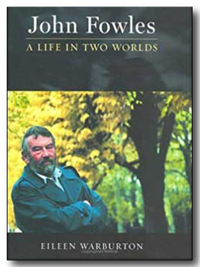
Wormholes, a book of essays, was published in May 1998. The first comprehensive biography on Fowles, John Fowles–A Life in Two Worlds, was published in 2004, and the first volume of his journals appeared the same year, followed by volume two in 2006.
John Fowles died on November 5, 2005 after a long illness. Read an obituary and an appreciation by clicking here.