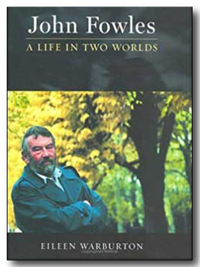
John Fowles died on Saturday, November 5, 2005. Read three different obituaries at:
http://news.bbc.co.uk/1/hi/entertainment/arts/2880967.stm
http://www.nytimes.com/2005/11/08/books/08fowles.html?_r=1
http://books.guardian.co.uk/comment/story/0,16488,1636778,00.html
And here is an interesting article:
http://books.guardian.co.uk/review/story/0,,1668489,00.html
John Fowles–An Appreciation
by Bob Goosmann
John Fowles was a great writer and a very unique man. In addition to producing two of the finest novels of the 20th Century–The Magus and The French Lieutenant’s Woman–he was a brilliant essayist and a keen observer of nature. He was also a man of liberal thought willing to stand up to authority (to the detriment of his reputation with the establishment) and fight for such issues as conservation and the environment.
I first met Fowles in San Francisco during a 1998 speaking tour to promote his new book Wormholes. He graciously signed books for about an hour after his on-stage interview, and I was struck by how soft-spoken and friendly he was–not your typical famous person with an oversized ego.
The following year I had the rare pleasure of spending about an hour with him at his home in Lyme Regis, England. When I arrived at his house, I was led through to the back yard and found Fowles quietly staring out toward his much-beloved garden. In the distance was the Cobb–made famous from the opening scene of The French Lieutenant’s Woman–stretching out from the coast into the sea. It was a surreal moment, to be sure. Yet when Fowles noticed me and came over to where I was standing, I might have been paying a visit to a distant great uncle and not a world-famous author, such was his friendliness and lack of affectation.
We subsequently sat in the kitchen and chatted over a beer, and I proceeded to attempt to remember the numerous questions I was anxious to ask him. Much of the ensuing hour is now just a blur, but I do recall asking about The Magus, my favorite novel from his oeuvre. I had always wondered what Fowles’ preferred aftermath was for Nicholas and Alison, and I tried to get him to talk about it. But he just smiled and gently shook his head–a quiet reminder that The Magus, like all of his fiction, was as much about the reader’s interpretation as the author’s.
Fowles in his later years was portrayed by the mainstream media as everything from a curmudgeon to a recluse, a reputation that he seemed to cultivate in a wry sort of way. And his published diaries indicate that he could be a bit of a bastard (in his own words), especially in his younger days. He certainly was not without his faults, and at times it seems he was more comfortable with nature than with his fellow man. Still, I think he was an individual with a good heart who was deeply concerned with the human condition and the plight of mankind.
It is The Magus, in my opinion, that will ultimately be considered his masterpiece. Certainly it was the novel closest to his heart (he liked to refer to it as his “naughty little child”) and the fact that he took the time to revise it 11 years after its original publication is telling. It is by far the Fowles title regarding which I receive the most correspondence on this web site.
When Fowles and I had finished our beer and he had walked with me to the front door of his house, I thanked him for providing me with one of the great experiences of my life. He smiled and said “you’re welcome,” and I could see in his face that he was actually pleased to have given me such a gift. I will never forget that smile. Genius is rare, but genius combined with kindness and humility rarer still.